.jpeg)
Causal & Cognitive Intelligence
Understand the mechanism.
Then let reality judge it.
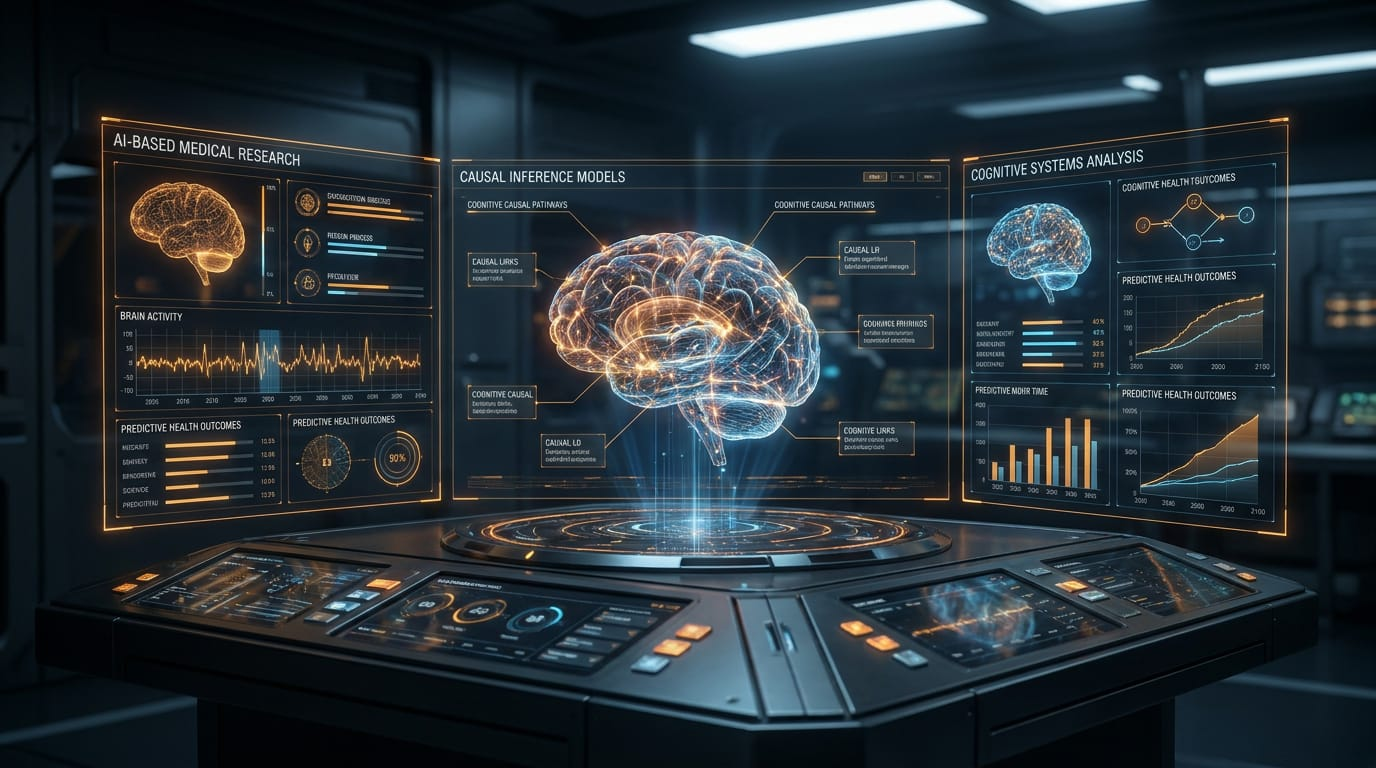
Pythology is building an evidence-grounded reasoning architecture that keeps observation, inference, forecast and counterfactual scenario separate. EarthNet is its first live proving ground; Prometheus commits forecasts; Decision Futures compares consequential choices; Sentinel gives authorised humans a way to interrogate the chain.
Core distinction
Correlation, prediction and causation
are different questions.
A model may forecast an outcome well without knowing whether changing one variable would alter that outcome. Pythology keeps these claim types visibly separate.
What varies together?
Useful for finding relationships, but vulnerable to confounding, selection effects and hidden common causes.
What should happen next?
A testable expectation that can later be scored. Accuracy alone does not prove the proposed mechanism.
What could make the change happen?
Requires explicit mechanisms, assumptions, alternatives, time order, contradictory evidence and tests capable of weakening the explanation.
Shared reasoning architecture
From evidence to mechanism,
choice and learning.
The purpose of the stack is not to make a model sound certain. It is to make the path from evidence to belief inspectable enough that a human can challenge it and later determine whether it deserved confidence.
Preserve the state
Source, timestamp, missing information, contradictions and observation quality remain visible.
Compare mechanisms
Keep plausible explanations and confounders alive instead of quietly selecting the first persuasive story.
Commit the forecast
State what should happen before the answer is known, preserve uncertainty and freeze the original record.
Compare choices
Where a genuine decision exists, branch from the same frozen evidence and compare conditional downstream consequences.
Interrogate the reasoning
Ask why branches differ, what is degraded, which assumption is weakest and what evidence could reverse the conclusion.
Calibrate against reality
Resolve forecasts and the decision actually taken against later evidence without rewriting the original belief.
Prometheus
A forecast becomes useful
when it can be wrong.
Prometheus creates timestamped, falsifiable expectations from the current evidence and causal state. Forecast confidence remains labelled and is only strengthened by accumulated resolved outcomes, not by how convincing the explanation sounds.
Decision Futures
What changes if
the choice changes?
Decision Futures extends Prometheus from baseline forecasting into explicit counterfactual branches. It is used only where a meaningful decision can affect a measurable outcome and the comparison can be made responsibly.
What if nothing changes?
Start from the same frozen evidence and causal state used by Prometheus.
What if we choose differently?
Pre-register a small number of feasible interventions, assumptions and expected consequences before the answer is known.
Score only what reality tested.
If humans choose branch B, B can be compared directly with the later outcome. Unchosen A and C remain counterfactual hypotheses until separately supported.
Across Pythology
One reasoning discipline.
Different evidence worlds.
The architecture can transfer, but confidence cannot. Planetary, biological and physical systems each require their own evidence model, mechanisms, validation and calibration history.
EarthNet
Live hazards, infrastructure pressure and wider planetary context create a prospective proving ground for forecasts and human-impact decisions.
Explore EarthNet →Biological Intelligence
Evidence, multi-omic state, molecular mechanisms and experiments support domain-specific causal and decision reasoning.
Explore Biological Intelligence →Physical Intelligence
Physics constrains engineering branches and measured tests or field outcomes remain the validation target.
Explore Physical Intelligence →Research foundations
Causal inference and representation learning.
These sources establish research foundations only and do not imply endorsement of Pythology.
Causal Inference: What If
Open textbook on causal questions, interventions and observational evidence.
Open source →Toward Causal Representation Learning
Research agenda connecting representation learning with causal structure.
Open paper →Elements of Causal Inference
Foundations and algorithms for causal discovery and inference.
Open source →Research and deployment collaboration
Causal systems require domain evidence.
Pythology is interested in discussions with organisations holding well-defined observations, intervention histories, measured outcomes or simulation environments suitable for prospective evaluation.