.jpeg)
Physical Intelligence · Research Programme
Understand the machine.
Then test the decision.
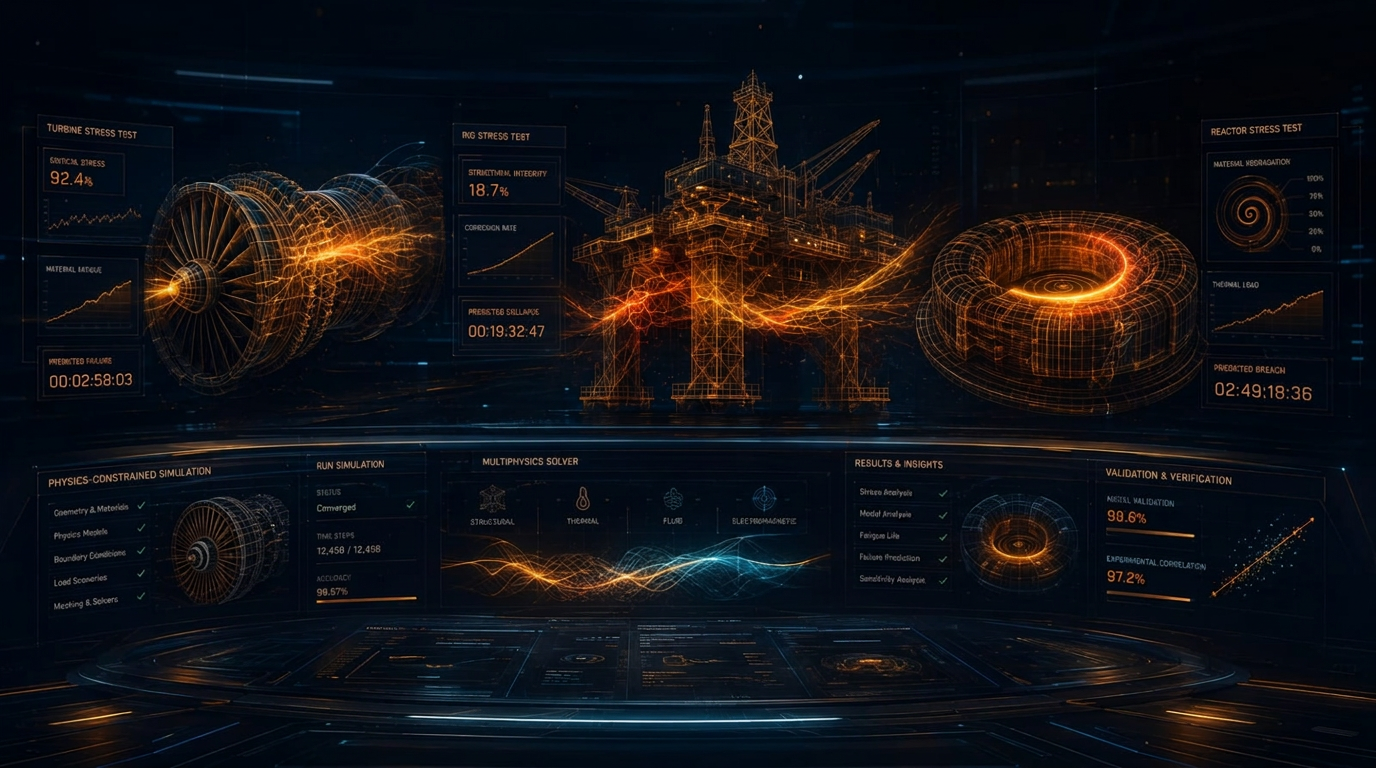
Pythology is researching vertically specialised models that combine engineering geometry, simulation, physical testing and field data while remaining constrained by known physics, calibrated uncertainty and measurable outcomes.
What physical intelligence means
A world model for one
high-value physical workflow.
The goal is not a universal simulator. It is a validated decision-support model for a narrow engineering problem where simulation, testing or operational evidence is expensive, slow or constrained.
Design and operating context
Geometry, materials, boundary conditions, process history, telemetry and measured state.
Physically constrained learning
Learned representations tied to conservation, dimensional consistency, solver evidence and extrapolation warnings.
Engineering decision support
Rapid comparison, risk screening, conditional futures and calibrated uncertainty — never certification authority.
Leading wedge
Aerospace durability
and engine health.
This remains a competing research hypothesis, not a fixed commercial claim. It is attractive because failure is expensive, simulation is mature and outcomes can be measured.
Stress and temperature
Estimate high-risk fields under defined geometry and operating conditions.
Fatigue and creep
Model damage accumulation using material properties, loads and validated history.
Remaining useful life
Compare degradation trajectories from sensors, maintenance and field outcomes.
Pythology Decision Futures · Physical domain
Different engineering decisions.
Different physical outcomes.
The same Decision Futures capability used with EarthNet can be applied here, but with physics and measured engineering evidence constraining every branch.
Continue current operation
Prometheus records the expected physical trajectory under the current state and operating assumptions before a decision changes the system.
Change the intervention
Maintenance, load redistribution, repair, operating-envelope adjustment, alternate material or another defined engineering choice becomes a conditional branch.
Compare consequences
Trace stress, degradation, bottlenecks, second-order effects and uncertainty back to the changed decision rather than presenting a single unexplained score.
Prospective testing
Freeze the decision before
the machine reveals the answer.
Where a real maintenance or operational decision can be observed, Pythology can freeze the evidence state, commit a baseline and alternative branches, then compare the enacted choice with what physically occurred later.
01 · Freeze state
Record telemetry, geometry, material state, history and uncertainty at the decision point.
02 · Commit branches
Define a small set of feasible choices before the outcome is known.
03 · Observe action
Record the actual maintenance or operating decision and any important deviations.
04 · Measure outcome
Use inspection, telemetry, solver comparison or field evidence to score what can legitimately be evaluated.
05 · Calibrate
Keep misses in the record and update future confidence without rewriting the original case.
Why it matters to Pythology
The bridge from digital intelligence
to the engineered world.
Physical Intelligence gives Pythology a research path into industrial systems where validated models, proprietary histories and prospective decision records can become unusually durable technical assets.